I want to talk about something my patients have started asking me about in clinic — and something I find genuinely fascinating as a dentist. Artificial intelligence is entering dental practice, and the conversation around it is often either breathlessly optimistic or quietly anxious. My honest position sits somewhere more interesting than either extreme.
Let me tell you what AI is actually doing in dentistry right now — not in a decade, not theoretically — and then I'll tell you where I stand as the person holding the instruments.
What AI Is Already Doing — Right Now
Reading X-rays with extraordinary accuracy
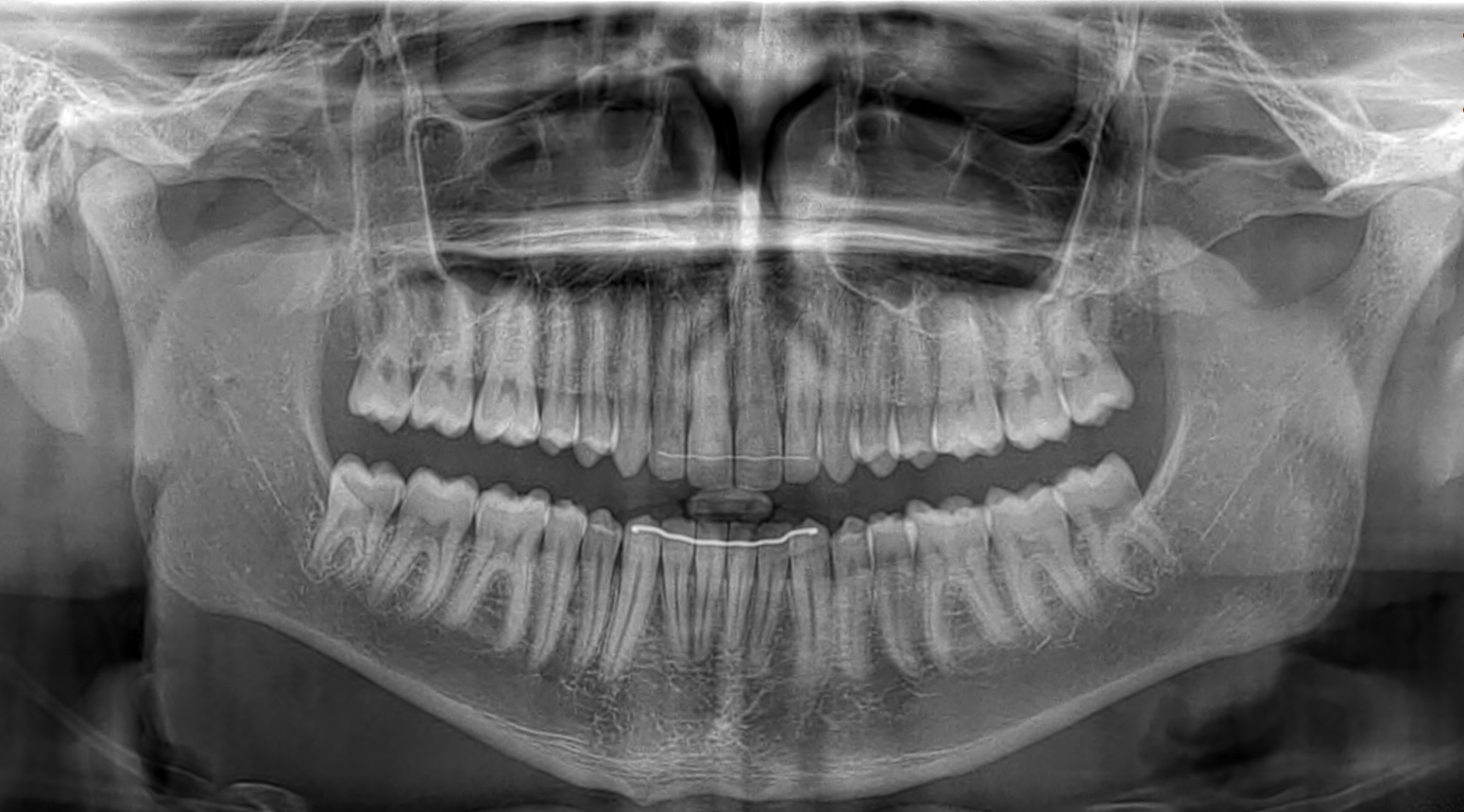
This is the area where AI has moved fastest and arguably proven itself most convincingly. AI-driven software can analyse dental X-rays with remarkable accuracy — detecting cavities, early gum disease, and subtle bone changes at stages that are genuinely difficult for the human eye to catch in a busy clinical day. A 2024 systematic review found that AI models matched or exceeded experienced dentists in detecting interproximal cavities on bitewing X-rays. That is not a small claim.
In practical terms: AI doesn't miss the small cavity hiding in the contact point between two teeth because it got distracted, was running late, or had seen forty patients that day. It applies the same attention to every image, every time.
Treatment planning and outcome prediction
Clear aligner companies — Invisalign among them — have been using AI for years to plan tooth movement and predict treatment outcomes. The software analyses thousands of past cases to model how your specific teeth will respond to specific forces over time. The result is a treatment plan that is more precise and more predictable than what manual planning alone could produce.
This is not hypothetical. When I plan an Invisalign case, AI has already done significant work before I review the simulation. I make clinical judgements on top of that foundation — but the foundation is robust.
Digital smile design
AI-powered smile design tools allow patients to see a realistic simulation of what their smile could look like before any treatment begins. This is genuinely transformative for cosmetic dentistry — it changes the conversation from abstract ("I want a nicer smile") to specific ("I want this particular outcome"), which means better informed patients and better clinical alignment before we start.
Patient communication and follow-up
On the administrative side, AI is helping dental practices with appointment reminders, post-treatment follow-up, and answering common patient questions outside of clinic hours. In a city like Dubai, where patients often work demanding schedules and communicate primarily via WhatsApp, this kind of responsive availability matters.
What I Actually Think About All of This
Here is my honest position, as someone who went to dental school, trained clinically, and then chose to build a practice around something I believe AI cannot replicate: human judgment in context.
I am genuinely excited about AI as a diagnostic tool. The idea that a piece of software can flag a cavity I might have missed on a busy Wednesday clinic day, or identify early bone loss that would otherwise take another year to become clinically obvious — that excites me. Catching things earlier means simpler treatment, less cost, and less discomfort for my patient. I am entirely in favour of anything that makes me a better clinician.
What I am more cautious about is the narrative that positions AI as a replacement for clinical judgment and the therapeutic relationship between a dentist and a patient. A patient who comes to me anxious about their first root canal is not presenting a data problem. They are bringing their history, their fear, their specific anatomy, and a set of preferences I need to understand before I pick up an instrument. No algorithm currently accounts for that.
The TikTok problem AI cannot solve
One of the most concerning trends I am seeing right now — and it is directly relevant to AI's role — is the rise of DIY dental fixes driven by social media. Over 45% of people aged 18–24 report making health decisions based on social media content. People are filing their own teeth with nail files. Using superglue for veneers. Attempting DIY whitening with household chemicals.
The sophistication of AI dental diagnostics means nothing if the patient has already caused irreversible enamel damage before they sit in the chair. The human side of dentistry — building trust, educating patients, being accessible enough that people ask before they experiment — remains entirely irreplaceable.
What This Means for You as a Patient
If you are a patient at my clinic in JLT, here is what AI integration means practically for your care:
- More accurate diagnosis. The combination of my clinical examination and AI-assisted X-ray analysis means early problems get caught earlier — when treatment is simpler and less invasive.
- More predictable cosmetic outcomes. If you are considering veneers, whitening, or Invisalign, digital design tools mean you see the proposed result before we begin — not after.
- The same person across the table. The AI assists. I decide. I treat. I follow up. The relationship is between us — and that is not changing.
The Broader Picture
Dentistry is, at its core, a discipline of detail. The difference between a good restoration and a great one is often 0.2mm. The difference between a patient who stays for twenty years and one who leaves after one visit is often a single conversation handled with or without care. AI excels at pattern recognition across vast datasets. It does not yet excel at the granular, tactile, relational work that happens in a clinical encounter.
I expect that to evolve. Robotics are entering periodontal surgery. AI diagnostics will become standard of care across most developed dental markets within this decade. The dentist of 2035 will use AI the way I currently use an intraoral camera — as a tool that extends my clinical capability, not one that substitutes for it.
I am paying attention to all of it. I am selectively incorporating tools that make your care better. And I am not particularly worried about what it means for dentistry as a human practice — because the most important parts of what I do have always been irreducibly human.